
America's Auction Channel
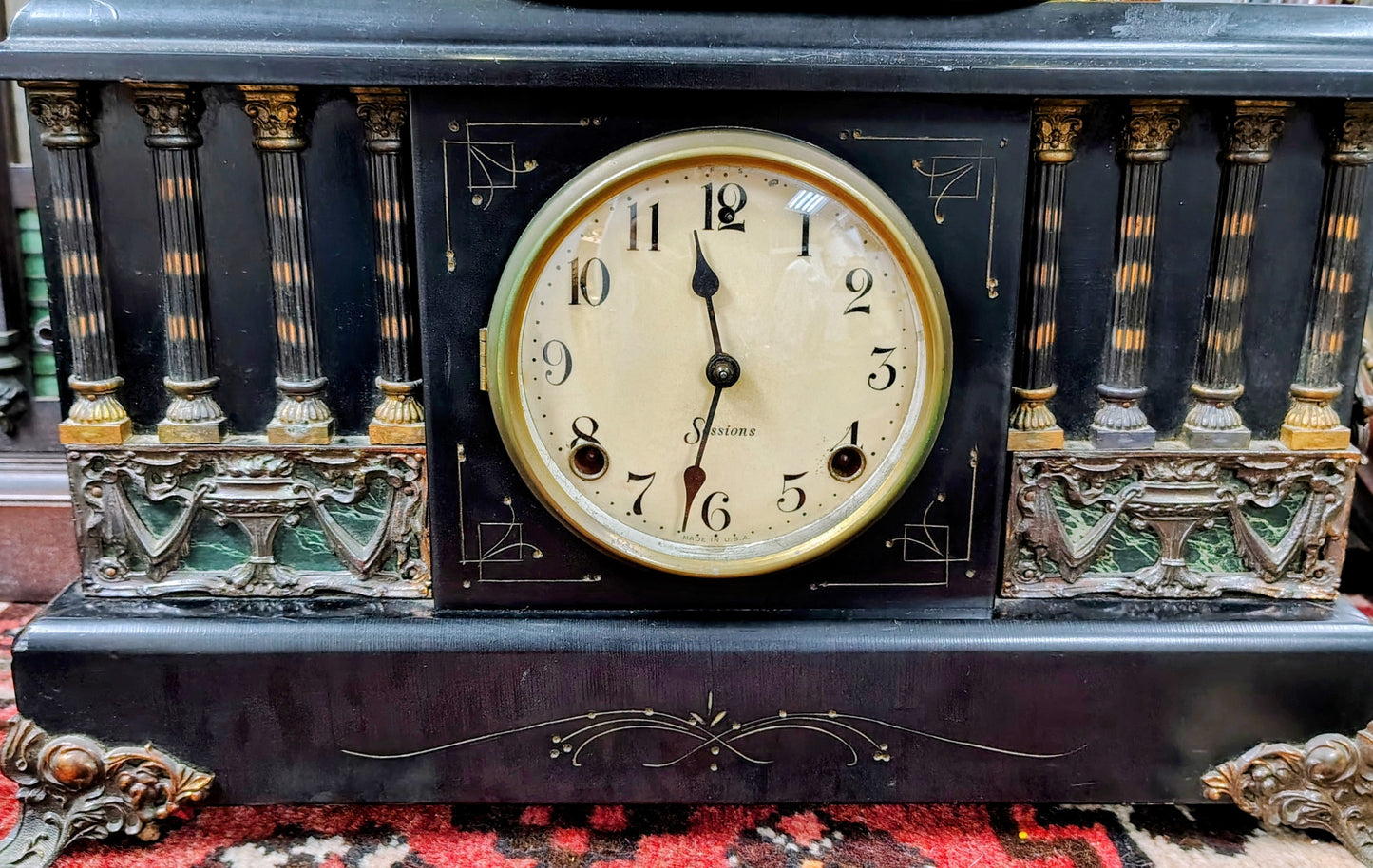
Antique 1920-1949 Sessions Victorian Ormolu Mantel Clock
Antique 1920-1949 Sessions Victorian Ormolu Mantel Clock
Regular price
$1,599.97 USD
Regular price
Sale price
$1,599.97 USD
Unit price
per
Shipping calculated at checkout.
Couldn't load pickup availability
Antique Victorian Ormolu Mantel Clock
estimated era- 1920-1949 Century
11in x 16 1/2in
Made by Sessions
The Sessions Clock Company was a major American clock manufacturer based in Forestville, Connecticut. It was originally the E.N. Welch Company, but in 1903, William E. Sessions and his family acquired a controlling interest and reorganized it as The Sessions Clock Company.
Early Years (1903–1933): Sessions produced mechanical clocks, including mantel clocks, wall clocks, and regulator clocks. They manufactured movements, cases, dials, and castings in-house.
Shift to Electric Clocks (1930s): As the industry moved toward electric clocks, Sessions expanded production to include timers for radios and televisions.
Mid-20th Century Changes (1956–1969): The company was acquired in 1956 by a firm interested in its timing devices. It continued operations until 1969, when market changes led to liquidation.
Victorian ormolu mantel clocks are exquisite timepieces that reflect the opulence and craftsmanship of the 19th century. The term inormoluin comes from the French phrase or moulu, meaning inground goldin, referring to the technique of gilding bronze with a mercury-gold amalgam.This method was widely used in France and England during the 18th and 19th centuries, particularly in the Victorian era (1837–1901).
Ormolu Technique: The process involved applying a gold-mercury mixture to bronze, then heating it to evaporate the mercury, leaving behind a rich gold finish. Due to health concerns, this method was largely abandoned by the late 19th century, replaced by safer electroplating techniques.
Victorian Design Influence: These clocks often featured intricate floral motifs, cherubs, mythological figures, and classical themes, reflecting the Rococo and Neoclassical styles.
French Craftsmanship: Many ormolu mantel clocks were produced in France, where master artisans collaborated—bronze casters, gilders, and clockmakers—to create elaborate designs.
British Adaptations: In England, ormolu clocks were highly sought after by the aristocracy, often displayed in grand estates and palaces.
Mantel Clock Evolution: The mantel clock design originated in France in the 1750s, evolving into more decorative forms by the Victorian era.
Although we do our best to research and present information and data accurately on all of these collectible estate items we are not appraisers curators or authenticators. Please bid accordingly; All estate items are non returnable non refundable sold as-is where-is with no warranties expressed or implied.
estimated era- 1920-1949 Century
11in x 16 1/2in
Made by Sessions
The Sessions Clock Company was a major American clock manufacturer based in Forestville, Connecticut. It was originally the E.N. Welch Company, but in 1903, William E. Sessions and his family acquired a controlling interest and reorganized it as The Sessions Clock Company.
Early Years (1903–1933): Sessions produced mechanical clocks, including mantel clocks, wall clocks, and regulator clocks. They manufactured movements, cases, dials, and castings in-house.
Shift to Electric Clocks (1930s): As the industry moved toward electric clocks, Sessions expanded production to include timers for radios and televisions.
Mid-20th Century Changes (1956–1969): The company was acquired in 1956 by a firm interested in its timing devices. It continued operations until 1969, when market changes led to liquidation.
Victorian ormolu mantel clocks are exquisite timepieces that reflect the opulence and craftsmanship of the 19th century. The term inormoluin comes from the French phrase or moulu, meaning inground goldin, referring to the technique of gilding bronze with a mercury-gold amalgam.This method was widely used in France and England during the 18th and 19th centuries, particularly in the Victorian era (1837–1901).
Ormolu Technique: The process involved applying a gold-mercury mixture to bronze, then heating it to evaporate the mercury, leaving behind a rich gold finish. Due to health concerns, this method was largely abandoned by the late 19th century, replaced by safer electroplating techniques.
Victorian Design Influence: These clocks often featured intricate floral motifs, cherubs, mythological figures, and classical themes, reflecting the Rococo and Neoclassical styles.
French Craftsmanship: Many ormolu mantel clocks were produced in France, where master artisans collaborated—bronze casters, gilders, and clockmakers—to create elaborate designs.
British Adaptations: In England, ormolu clocks were highly sought after by the aristocracy, often displayed in grand estates and palaces.
Mantel Clock Evolution: The mantel clock design originated in France in the 1750s, evolving into more decorative forms by the Victorian era.
Although we do our best to research and present information and data accurately on all of these collectible estate items we are not appraisers curators or authenticators. Please bid accordingly; All estate items are non returnable non refundable sold as-is where-is with no warranties expressed or implied.
Materials
Materials
Shipping & Returns
Shipping & Returns
Dimensions
Dimensions
Care Instructions
Care Instructions