
America's Auction Channel
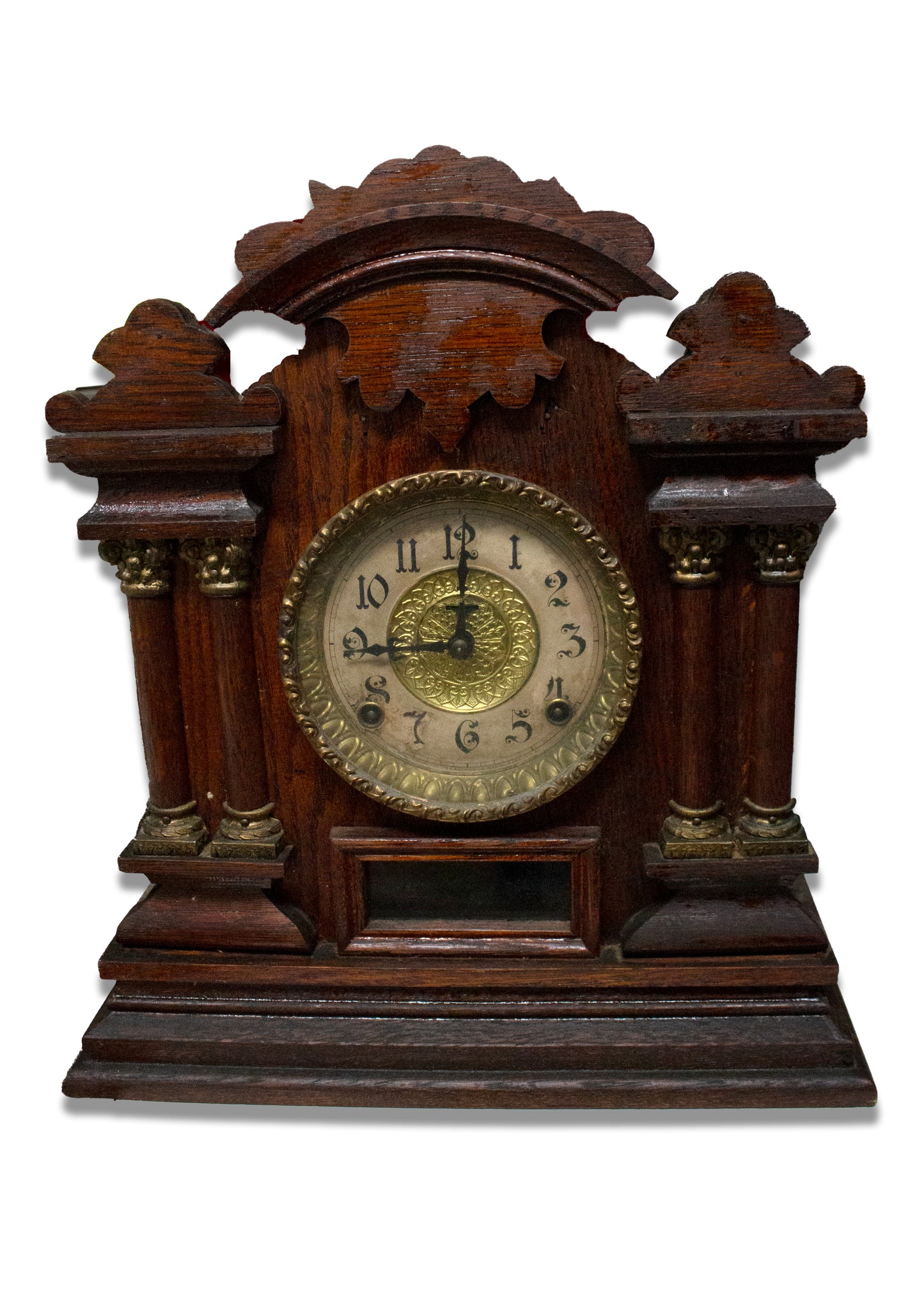
Vintage Late19th/20th Century Ingraham Mantel Clock
Vintage Late19th/20th Century Ingraham Mantel Clock
Regular price
$899.95 USD
Regular price
Sale price
$899.95 USD
Unit price
per
Shipping calculated at checkout.
Couldn't load pickup availability
16in x 14 1/4in x 5 3/4in
believed to be Late 19th to Early 20th Century (c. 1890s–1910s):
The ornate case style with columns and classical capitals reflects the Victorian and early Edwardian taste for Greco?Roman revival motifs.
The use of oak cases became popular in the late 19th century as a durable, richly grained wood.
The 8?day brass movement was standard for quality American mantel clocks of this period.
Case:
Solid oak with rectilinear form, accented by four columns.
Columns topped with Greco?Roman style capitals, a hallmark of late Victorian neoclassical design.
Dial & Bezel:
Brass bezel with convex glass protecting the dial.
Paper or painted metal dial with Roman or Arabic numerals.
Movement:
Brass mechanical movement, 8?day time and strike, striking on a gong or bell.
Manufactured by the E. Ingraham Company, Bristol, Connecticut.
Design Influence:
The classical column motif was meant to evoke permanence and grandeur, aligning with the neoclassical revival in American decorative arts.
The E. Ingraham Company:
Founded by Elias Ingraham in 1831, incorporated in 1884.
Known for innovative case designs and affordable yet stylish clocks.
Mantel Clock Popularity:
By the late 19th century, mantel clocks were a centerpiece of American parlors, combining utility with decorative appeal.
Greco?Roman Revival:
Reflects the broader Victorian fascination with classical antiquity, often seen in architecture and furniture.
Ingraham adapted these motifs into clock cases to appeal to middle?class buyers seeking refinement.
All estate items may show wear and conditions pertinent to their individual time periods. Thus they are sold as-is where-is, no warranties expressed or implied and are non returnable and non refundable.
believed to be Late 19th to Early 20th Century (c. 1890s–1910s):
The ornate case style with columns and classical capitals reflects the Victorian and early Edwardian taste for Greco?Roman revival motifs.
The use of oak cases became popular in the late 19th century as a durable, richly grained wood.
The 8?day brass movement was standard for quality American mantel clocks of this period.
Case:
Solid oak with rectilinear form, accented by four columns.
Columns topped with Greco?Roman style capitals, a hallmark of late Victorian neoclassical design.
Dial & Bezel:
Brass bezel with convex glass protecting the dial.
Paper or painted metal dial with Roman or Arabic numerals.
Movement:
Brass mechanical movement, 8?day time and strike, striking on a gong or bell.
Manufactured by the E. Ingraham Company, Bristol, Connecticut.
Design Influence:
The classical column motif was meant to evoke permanence and grandeur, aligning with the neoclassical revival in American decorative arts.
The E. Ingraham Company:
Founded by Elias Ingraham in 1831, incorporated in 1884.
Known for innovative case designs and affordable yet stylish clocks.
Mantel Clock Popularity:
By the late 19th century, mantel clocks were a centerpiece of American parlors, combining utility with decorative appeal.
Greco?Roman Revival:
Reflects the broader Victorian fascination with classical antiquity, often seen in architecture and furniture.
Ingraham adapted these motifs into clock cases to appeal to middle?class buyers seeking refinement.
All estate items may show wear and conditions pertinent to their individual time periods. Thus they are sold as-is where-is, no warranties expressed or implied and are non returnable and non refundable.
Materials
Materials
Shipping & Returns
Shipping & Returns
Dimensions
Dimensions
Care Instructions
Care Instructions